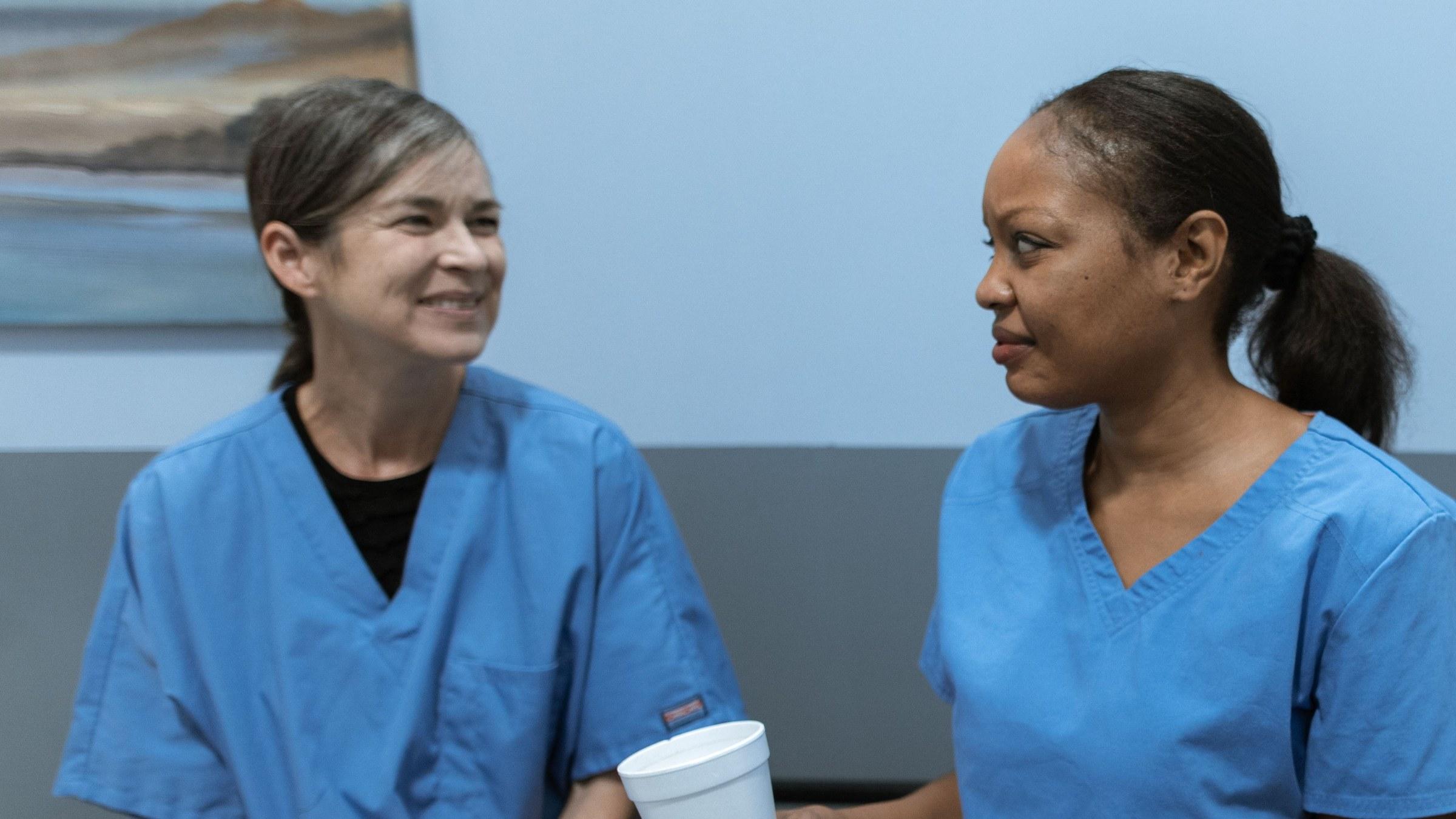
She's been a nurse for eight years. She's the one everyone turns to when a shift goes sideways. She knows how to calm a worried family, recognize a change in a patient's condition, and help a new colleague find their confidence.
Then she accepts a nurse manager position.
Now she's responsible for staffing decisions, managing conflict, and leading people who were her peers just a few weeks ago. Tomorrow, she has to address a performance issue with someone she's worked alongside for years. She's been thinking about that conversation all weekend.
She's a great nurse. She knows that. But she's beginning to wonder whether she'll be a great leader.
What she could really use right now is someone who's been through this transition. Someone she can talk to without worrying about how her questions might be perceived. Someone who can help her work through a difficult situation without simply telling her what to do.
She needs a mentor.
When we talk about nursing mentorship, though, we tend to focus on new nurses. And understandably so. We've invested significant time and resources into helping nurses transition from school into practice. Residency programs, preceptorships, and structured onboarding are important parts of that work.
But somewhere along the way, we started treating mentoring as something nurses graduate from.
I've never understood that.
A nurse doesn't stop needing guidance because they've become clinically competent. If anything, the further someone advances in their career, the more complicated some of their challenges become.
And the people who appear the most confident aren't always the ones who feel that way.
Key Takeaways
- Support shouldn't end when residency does. According to the 2026 NSI report, nurses with one to five years at a hospital accounted for nearly half of RN separations. Yet hospitals report fewer retention strategies for tenured nurses than for new hires.
- Experienced nurses become beginners again. Changing specialties, entering advanced practice, and moving into leadership all bring challenges that clinical experience alone doesn't prepare someone to navigate.
- Mentoring needs to be available throughout a nursing career. Research suggests benefits for retention and leadership development, although we still need stronger evidence about mentoring for mid- and late-career nurses.
What Happens After Residency Ends?
Think about the day a nurse completes residency. The preceptor signs off. The cohort celebrates. Everyone recognizes how much the nurse has learned over the past year.
And then Monday comes.
The nurse is still learning, still encountering situations they haven't experienced before, and still trying to figure out where they want their career to go. But the regular check-ins and structured support may no longer be there.
I think of this as the month 13 question: What support is available the day after residency ends?
The 2026 NSI National Health Care Retention & RN Staffing Report found that 74% of responding hospitals had a formal retention strategy. More than 80% had strategies specifically designed to support newly hired nurses, but that figure dropped to 62.4% for more tenured nurses.
Meanwhile, nurses with one to five years at a hospital accounted for nearly half of RN separations. Those with one to two years of tenure represented 21.9% of separations, while another 27.7% came from nurses with two to five years.
One important distinction: NSI measures tenure at the hospital, not total nursing experience. An experienced nurse who joins a new organization starts at year zero in those figures. And the data doesn't tell us whether mentoring would have prevented those departures.
Still, the difference in how hospitals support new and tenured nurses is worth examining.
We've put a lot of effort into helping nurses get started. I'd like to see us put that same level of thought into helping them figure out what comes next.
For more on supporting nurses during their first year, see our guide to building a nurse residency and mentorship program.
Experienced Nurses Become Beginners Again, Too
I think we sometimes underestimate how difficult career transitions can be for experienced nurses.
Consider a medical-surgical nurse who's spent twelve years becoming exceptionally good at what she does. She decides to move into oncology because she wants to learn something new and expand her career.
She's excited about the opportunity, but suddenly she's the person asking questions instead of answering them. She's learning unfamiliar treatments, adjusting to a different patient population, and relying on colleagues with far less overall nursing experience but much more experience in her new specialty.
That can be humbling.
A 2017 integrative review in the Journal of Clinical Nursing found some evidence of initial shock and emotional stress among experienced nurses transitioning into new clinical areas. Nurses valued support during those transitions, but the availability of that support varied.
A preceptor can help our oncology nurse learn the clinical skills she needs. But there are other conversations she might want to have.
What if she's worried she made the wrong decision? What if she's struggling with no longer being the expert? What if she's embarrassed to admit how much she's questioning herself?
Those feelings don't disappear because someone has years of nursing experience.
The same thing happens when a nurse practitioner takes on a new scope of practice or a nurse manager moves into a director position. The responsibilities change, the expectations change, and sometimes the person's confidence takes a hit along the way.
I've spent much of my career working with mentoring programs, and one thing I believe strongly is that we need to pay more attention to these transitions.
They're exactly the moments when having someone who's already walked that road can make a difference.
Mentoring, Preceptorship, Onboarding, and Coaching Aren't the Same Thing
This is an important distinction because I often hear organizations describe the support they provide during onboarding or preceptorship as mentoring.
Sometimes mentoring is part of those experiences. But the terms aren't interchangeable.
The Association for Nursing Professional Development describes a preceptor as someone who guides, assesses, and validates the competencies needed for a nurse to transition into a new role, specialty, or environment.
The International Coaching Federation defines coaching as a collaborative process that helps people think through challenges and make progress toward their goals.
Here's how I think about them:
| Preceptorship | Onboarding | Mentoring | Coaching | |
|---|---|---|---|---|
| Purpose | Safe, independent practice in a new role or setting | Bring a nurse into the organization | Growth, perspective and career direction | Progress on a specific goal |
| Who | An experienced nurse on the unit, prepared to precept | HR, nursing professional development, the manager | An experienced nurse or leader, ideally outside the reporting line | A trained coach, internal or external |
| When | Orientation to a new unit, specialty or role | The first weeks and months in a new organization | Any career stage, especially transitions | When a nurse wants to change something specific |
| How long | Until competence is validated | Set by the organization | A defined match period, renewable | A defined series of sessions |
| Success looks like | The nurse practices safely on their own | The nurse knows how things work and whom to ask | Clearer direction and someone to learn from | The nurse reaches the goal they set |
I don't see these as competing approaches. A nurse may benefit from all four, depending on what they're experiencing.
But I do think there's something different about having a mentor.
Imagine telling the person who's evaluating your readiness to practice, "I'm worried I made a mistake coming here."
Or telling your manager, "I'm not sure I want to stay in this specialty."
Some nurses have wonderful relationships with their preceptors and managers and would feel comfortable having those conversations. Others wouldn't, particularly if they're concerned about how their honesty might affect their evaluation or future opportunities.
A mentor outside the reporting relationship can give nurses another place to turn. They can explore their doubts, ask questions they might otherwise keep to themselves, and hear from someone who has faced similar decisions.
The mentoring relationship that helps a nurse find their footing early in their career probably isn't the same one they'll need when changing specialties, moving into advanced practice, or preparing for executive leadership.
That's why I believe healthcare organizations need to think beyond individual mentoring programs and consider how nurses can access the right relationships throughout their careers.
What Difference Can Career-Long Mentoring Make?
When I talk with nursing leaders about mentoring, retention often comes up early in the conversation. Given the cost of nurse turnover and the pressure on healthcare organizations, I understand why.
But I worry that when we focus exclusively on retention, we miss some of the reasons mentoring matters in the first place.
Helping Nurses Want to Stay
A 2014 systematic review on retaining experienced registered nurses examined twelve studies and found higher retention associated with individually targeted strategies, including mentoring. The researchers also acknowledged the limited evidence and noted that retention was strongest when organizations combined multiple interventions.
That's an important qualification.
Mentoring won't solve staffing problems, unreasonable workloads, or poor leadership. And we shouldn't suggest that it will.
But I do believe relationships influence how people experience their work.
When nurses know someone is invested in their growth and can help them see a future within the organization, that relationship may influence how they feel about staying.
Preparing Nurses for Leadership
I've seen how much thought organizations put into developing leadership competencies. That's important work.
A 2026 systematic review in the Journal of Nursing Management examined ten studies and found that mentoring programs had beneficial effects on healthcare managers' leadership competencies.
But knowing the principles of a difficult conversation and actually having that conversation with someone you've worked beside for years are two very different things.
A mentor gives an emerging leader someone to think with before and after those moments.
They can talk about what went well, what they'd do differently, and how to approach the next challenge. There's tremendous value in learning from another person's experience rather than having to learn every lesson the hard way.
Helping Nurses See a Future Within Their Organization
Career advancement was among the top five reasons staff RNs resigned in the 2026 NSI report.
That finding makes me think about how visible career opportunities really are to nurses.
A nurse may know their own unit extremely well but have little understanding of the roles, specialties, or leadership opportunities available elsewhere in the health system.
What happens when that nurse starts wondering about their next step?
Without someone to help them explore the possibilities, looking outside the organization may feel easier than figuring out how to grow within it.
I can't tell you how many nurses would stay because of mentoring. The research doesn't establish that.
But helping nurses understand the career opportunities available to them seems like a worthwhile investment, regardless.
Building a Culture of Nursing Excellence
When I think about the people who've influenced my career, some of the most important weren't the people who taught me a particular skill or delivered a formal training program.
They were the people who encouraged me to pursue opportunities I didn't think I was ready for, challenged my thinking, and helped me see possibilities I hadn't considered.
Now imagine what happens when those kinds of relationships become part of how nurses experience their workplace.
Experienced nurses share what they've learned with the next generation. Newer nurses bring fresh perspectives that challenge established ways of thinking. Leaders become more intentional about developing the people around them. And nurses have opportunities to learn from colleagues they might never encounter in their day-to-day work.
Over time, those relationships can help build a culture where nurses feel supported, share what they've learned, and continually challenge one another to improve. And when nurses are learning and growing together, that has the potential to influence the care they provide to patients.
This is something I think we should talk about more when we discuss nursing excellence.
For organizations pursuing or maintaining Magnet or Pathway recognition, mentoring can support the professional development, collaboration, and shared learning that are central to a strong nursing culture. But those principles aren't exclusive to designated organizations.
Every healthcare organization should want nurses who feel supported, are invested in one another's success, and have opportunities to grow throughout their careers.
A 2023 Canadian rapid review found that much of the nursing mentorship research has focused on early-career nurses, leaving a gap in our understanding of its benefits for mid- and late-career nurses.
We need to continue building that evidence. And as healthcare organizations evaluate their mentoring programs, I'd encourage them to look beyond participation and retention.
Are nurses learning from one another across specialties and career stages? Are they developing relationships outside their immediate teams? Do they feel comfortable seeking guidance and sharing their experiences? Are leaders helping create an environment where professional growth is encouraged?
Those are meaningful indicators of the kind of nursing culture we're building.
And ultimately, that's what I believe mentoring can contribute to: a workplace where nurses don't just develop their own careers, but actively help one another become better nurses and leaders.
For more on evaluating these relationships, see our guide to measuring nurse mentoring outcomes.
What Would It Take to Make Mentoring Available Throughout a Nursing Career?
I don't think most healthcare organizations need another collection of disconnected mentoring programs.
I'd rather see them take a look at the programs and relationships they already have, identify where nurses are well supported, and find the places where that support drops off.
Maybe there's an excellent residency program, but nothing for nurses who are three years into their careers and considering a change.
Maybe new nurse managers receive formal leadership training, but they don't have an experienced leader they can call when a difficult situation comes up.
Or maybe mentoring opportunities exist, but nurses don't know how to access them unless they're invited into a specific program.
Those are problems we can do something about.
If I were sitting down with a nursing leadership team to discuss this, I'd start with three questions:
- Where does structured support end for nurses in your organization, and what replaces it?
- When a nurse changes specialties or steps into advanced practice, management, or executive leadership, who do they learn from beyond their preceptor or manager?
- Can nurses find a mentor whenever they need one, or only when a formal program has an opening?
I'd be interested in the answers, especially if they differ across departments, specialties, or facilities.
That's where the opportunity lies. Not necessarily in launching more programs, but in making it easier for nurses to find the relationships they need as their careers change.
Mentoring Shouldn't Be Something Nurses Graduate From
I keep coming back to the nurse manager from the beginning of this article.
Tomorrow, she still has to have that difficult conversation with her former colleague. Having a mentor won't make the conversation easy, and it won't give her a script that guarantees everything goes perfectly.
But imagine how different she might feel walking into it after talking with someone who's been in her shoes.
Someone who helped her think through what she wanted to say, reminded her that difficult conversations are part of leadership, and offered to talk again afterward.
She'd still have to do the hard part herself. She just wouldn't have to figure it all out alone.
That's what I want more nurses to have access to, whether they're eighteen months into practice or twenty years into their careers.
Mentoring shouldn't end when nurses become experienced. It should evolve as they do.
Because no matter how far someone advances in their career, there's value in having someone in their corner.
Make Mentoring Part of Every Nurse's Career Journey
At Chronus, we help healthcare organizations build mentoring strategies that extend beyond residency, connecting nurses with experienced colleagues and leaders throughout their careers. Our nurse mentoring solution supports these relationships with intelligent matching, nursing-specific guided conversations, and tools to understand how mentoring is progressing.
If you're looking at how to make mentoring more accessible across your nursing workforce, I'd welcome the conversation.
Let's talk about building a nursing mentoring strategy that grows with your nurses.
Frequently asked questions
What is the difference between a preceptor and a mentor in nursing?
A preceptor teaches and assesses a nurse during orientation to a new unit, specialty or role, and confirms when they can practice independently. A mentor offers an ongoing relationship focused on growth and career direction, without evaluating performance. Most nurses benefit from both, ideally from different people.
Do experienced nurses need mentoring?
Many do, especially when changing specialty, moving into advanced practice, or stepping into management or executive roles. A 2017 integrative review found some evidence of initial shock and emotional stress among experienced RNs moving to a new clinical area.
Should a nurse mentorship program end after residency?
A residency has an end date, but a nurse's need for mentoring doesn't. In NSI's 2026 report, RNs with one to five years at their hospital accounted for about half of RN separations (21.9% with one to two years, 27.7% with two to five).
Nursing has shown it can build serious support for the move from school to practice. The open question is whether we bring the same intention to the transitions that follow. So here's my question for nursing leaders: if you mapped the entire nursing career journey in your organization, where would you find the biggest gaps in mentoring support?